A 1.7-billion-year-old quartzite ridge with a 60-foot tower, color-coded trails, an old quarry and a chairlift, 4.6 miles from downtown.
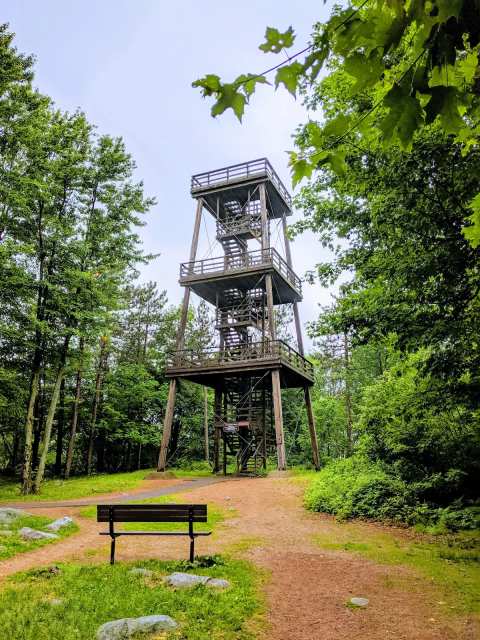
Climb the 60-foot tower at Rib Mountain State Park and the flat Wisconsin River valley opens out below you in every direction. The ridge behind that view is a hard quartzite spine about four miles long, formed roughly 1.7 billion years ago, and it stands 670 feet above the country around it. It rises higher above its surroundings than any other hill in the state, and the quarry, the ski runs and the stonework all follow from that.
What Rib Mountain actually is
Rib Mountain is a quartzite ridge that rises out of the flat plain west of the Wisconsin River, and at 1,924 feet above sea level it is the fourth-highest point in Wisconsin. It was once believed to be the state's high point until Timm's Hill, at 1,952 feet, took that title. The rock survived because quartzite resists erosion far better than the softer stone around it, which wore away over the ages and left the ridge standing.
Sponsored
The Ojibwe knew the ridge as O-pic-wun-a-se-be and used it as a lookout and a landmark, and voyageurs later steered by it too. Local folklore adds that Paul Bunyan is buried on the mountain, with Babe the Blue Ox resting nearby at Mosinee Hill. Wausau is the city at its foot, and the Woodson art museum downtown is about 4.6 miles from the summit in a straight line.
Getting to the top: hours, admission and the lift
The park is open every day from 6 a.m. to 11 p.m. all year, at 149801 State Park Road, just off US Highway 51 southwest of Wausau. A vehicle admission sticker is required, and you can buy one online or at the electronic kiosk outside the park office when the office is closed. People on foot get in free. Several lots serve the ridgetop, with small shelters, benches and picnic tables, and the park is a day-use area with no overnight camping.
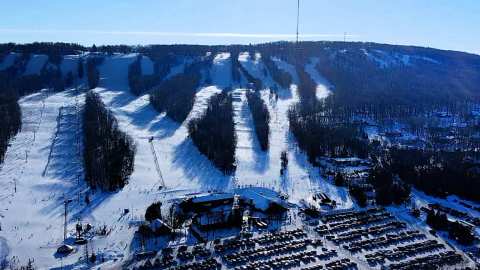
You have two ways up: drive and walk, or ride the Granite Peak chairlift. One reviewer called the chairlift ride the highlight of their visit, floating above the tree line to see the mountain from an angle the trails cannot give you. Another said the lifts run continuously so you can ride up and down more than once, and Visit Wausau points to the tower and the Comet Express for autumn color. A third reviewer disagreed on the look of it, saying the ski lifts spoil the view for a non-skier. Operating dates for the lift are set by the ski area, so check with Granite Peak before you plan around a ride.
The trails, color by color
More than 13 miles of trails cross the mountain, most are named by color, and over 8 of those miles are accessible to people with disabilities. The Gray trail is the quick way to the main features, crossing the north and south slopes to the 60-foot observation tower. The Blue trail, built by the Civilian Conservation Corps in the 1930s, has rock staircases and stretches of asphalt that make it the easiest surface underfoot. The Red trail has northern forest, a view of Hardwood Hill and a steep south section through birch and maple. If that steep stretch looks like too much, the Green trail makes an inner loop between the Red and Blue trails as a gentler alternative. The Yellow trail is the hardest, a wide wood-chipped path down the south slope through mature maple that also works as a winter snowshoe route.
The footing deserves respect, and reviewers say so plainly. One called the hiking rugged and warned of slippery rocks with no benches or handrails on the stretches they tried, and another found the small red gravel paths hard to walk in sandals. A third reviewer thought the trails were well maintained, so conditions clearly vary by path. Wear sturdy shoes, and carry the trail map, because the Wausau Pilot and Review recommends having it on your phone for the forks. Paper maps are also sold outside the park office, and the only restrooms are two pit toilets near the amphitheater and the tower.
The quarry, the sandpaper and the rock art
The Quarry trail runs from the Red trail to the old quartzite quarry on the west end of the hill, where the rock was cut from about 1893 into the early 1980s. The stone went into sandpaper at first, and the Wausau Sandpaper Company and the Wausau Quartz Company merged in 1905 to form Wausau Abrasives, which 3M bought in 1929. When 3M closed the quarry in the early 1980s, the land passed to the Wisconsin DNR.
The Turkey Vulture trail circles the old quarry with views of the pit and the country beyond, and vultures roost on the quarry walls in summer. A travel site lists the out-and-back version from Grouse Lane at 2.8 miles with 446 feet of climb, and says it can take up to 90 minutes. That same source said storm damage and downed trees affected the trail in late April 2026, so check the DNR before you plan around it. Quartz sparkles in the quarry rock in the sun, and visitors have arranged loose stones into words and a heart shape. Rangers kept the heart but ask people not to build more. Bouldering is allowed at the former quarry, but technical climbing is not because the rock is unstable.
The Dynamite trail is named for a storage site that 3M used for its mining, and a dynamite shed remains. The Homestead loop passes the foundations of the Knapp family farm, with a house, root cellar and barn, and a stand of hemlock. Ludwig and Katherine Knapp sold their 80 acres to a predecessor of Wausau Abrasives in 1901.
The Depression-era stonework and Granite Peak
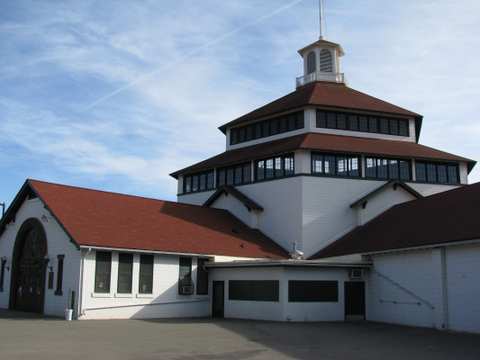
The Civilian Conservation Corps put a camp of about 250 men to work here in 1935, widening the road, cutting trails and ski slopes and building a picnic area and campground. The stone shelter house they finished in December 1939 is still used by the ski area today.
The ski story began early: in February 1938 the Central Ski Association Championship drew more than 465 participants and about 3,000 spectators. In 2006 the upper level of the shelter was dedicated to the 10th Mountain Alpine Division, because many of the soldiers who trained for it learned to ski on this hill. Note that the northern part of the Gray trail is closed during downhill ski season.
Planning the visit
The Wausau Pilot and Review, citing the DNR, reports at least 400,000 visitors a year and a record 640,000 in 2022, so expect company at the tower on a busy weekend. Dogs are welcome on trails on a leash of up to 8 feet, though some areas are closed to pets. Deer, foxes and bobcats live in the park, and birders watch for warblers, hawks and bald eagles. Hunting licenses apply in the park, so read the DNR rules before a late-fall walk.
For a bed, the Hilton Garden Inn is about 1.4 miles from the summit, and guests praise its Brazilian-style grill restaurant and pool. Families can pair the climb with Marathon County Park, about 3.1 miles away, where reviewers describe pine and shade trees, several playgrounds and a stadium for shows.
Pair the mountain with the free Leigh Yawkey Woodson Art Museum downtown, which keeps its admission free all year.
Rib Mountain is one stop among the things to do in Wausau, so build the rest of the day around it.
Take the Gray trail straight up or ride the lift, and you finish where you started, at the top of the 60-foot tower with the whole valley flat below you.
Frequently asked questions
Published September 28, 2026