Who built it, what the arches and statue mean, and what sits around it.
Huguenot Monument Franschhoek: the memorial stands at the top end of Huguenot Street, below the mountains, and it commemorates the French Huguenots who settled the valley. This guide covers why it was built, who designed it, what its arches and statue mean, and what to see around it.
It is about 0.9 km south-east of the tourist office, so it is easy to reach on foot.
Sponsored
What the Huguenot Monument is
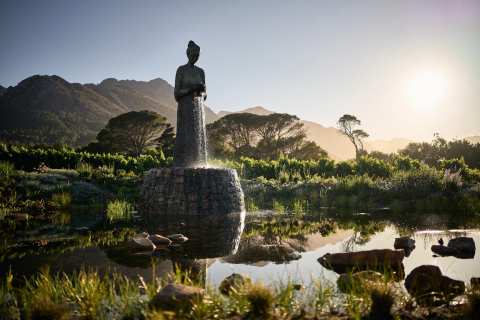
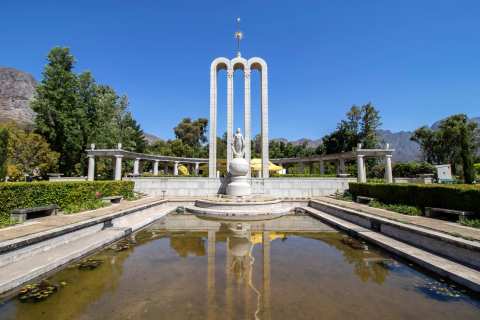
The monument is dedicated to the cultural influences that the Huguenots brought to the Cape Colony and, in time, to the whole of South Africa. Its central figure is a woman who personifies religious freedom, holding a Bible in one hand and a broken chain in the other.
The Huguenots were French and Belgian Protestants who fled religious persecution in Europe. They arrived at the Cape at the end of the seventeenth century.
How the monument came to be built
The idea came from Carel Christiaan de Villiers, a Cape Town architect and Huguenot descendant, who proposed a monument in Franschhoek for the 250th anniversary of the first Huguenots' arrival in 1938.
Building started in 1942 under J.C. Jongens, a young Dutch architect who had immigrated to South Africa.
The monument was completed in 1945 at a cost of £22,000. It was inaugurated in April 1948 by Dr A.J. van der Merwe.
Coert Steynberg, a South African sculptor, made the central female figure.
The structure is built of Paarl granite, with paving stones of Calvinia slate.
What the arches, the cross and the pool mean
The three high arches represent the Holy Trinity.
Above the arches sits the sun of righteousness, and above that the cross of the Christian faith.
The woman casts off a cloak of oppression, holds a Bible in her right hand and a broken chain in her left, and her pose stands for the end of religious subjugation.
The pool in front stands for the spiritual peace that followed a long struggle.
The Huguenots in the valley
French Huguenots arrived in this valley in 1688, and the village still tells that story through a museum, a monument and a main street of galleries, shops and cafés.
The garden and the mountain backdrop
The monument sits in a garden landscape with the Franschhoek mountains behind it. The best light for photos is early morning or late afternoon, when the stone is warm and the mountain edge is sharp.
The monument is set in a rose garden.
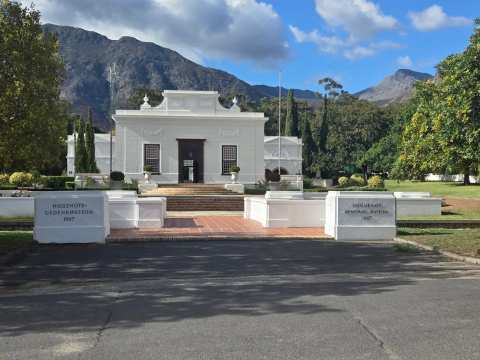
Visit the museum next door
The Huguenot Society of South Africa was founded in 1953, and the upkeep of the museum and the monument became its main focus.
What else to see near the monument
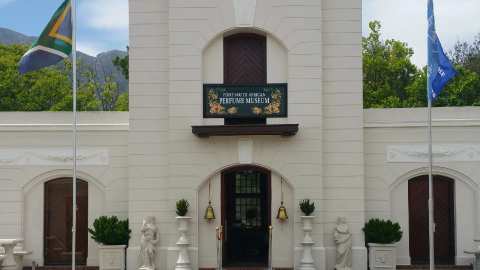
The perfume museum sits in the same precinct. It keeps a permanent collection of antique pieces and runs workshops where you can blend a custom fragrance.
A longer list of places within walking distance is in things to do within walking distance.
The Franschhoek Pass starts at the monument and is closed to traffic at the moment. The latest road status is in what to know before you drive it.
Practical tips for a visit
Walk down Huguenot Street from the village centre, and the monument rises at the far end.
Take a hat in summer and a jacket in winter, because the garden is open to the weather.
Check the museum's own notice for opening hours before you plan around a visit.
Frequently asked questions
Published November 9, 2026