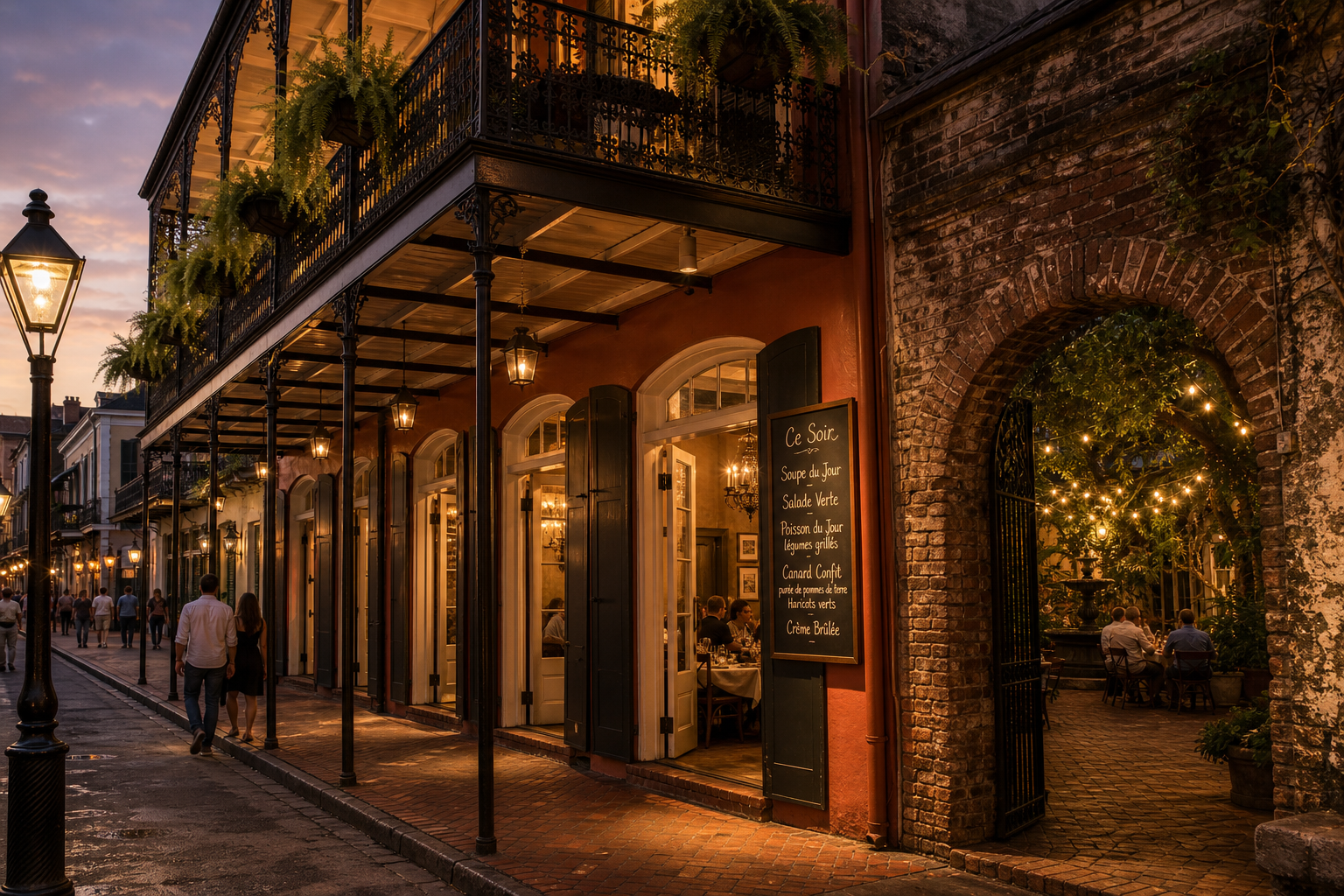
The most authentic meals in the French Quarter rarely sit on the most-photographed street.
Find your next French Quarter meal with confidence
Explore French Quarter restaurants and discover where locals actually eat, from century-old institutions to tucked-away neighborhood counters.
Creole cuisine is the foundation of French Quarter dining
The French Quarter's restaurant identity is built almost entirely on Creole cuisine, a cooking tradition that took shape in New Orleans through centuries of French, Spanish, African, Caribbean, Native American, German, and Italian influence. Creole cooking is defined by its complexity: tomatoes, butter, cream, and imported spices layered over the Holy Trinity of onion, celery, and bell pepper. Dishes like shrimp remoulade, oysters Rockefeller, crawfish bisque, and trout meunière are the result of that layered history. Understanding this distinction matters because visitors often arrive expecting "Cajun food" and find something more refined and sauced. Cajun cooking, by contrast, is one-pot and rural: gumbo, jambalaya, boudin, and crawfish boils built on bold cayenne heat with no cream sauces or elaborate presentation. In modern New Orleans, the two traditions have merged into what food writers sometimes call South Louisiana cuisine, but the French Quarter's fine dining rooms remain rooted in the Creole tradition.
The historic dining rooms that define the Quarter
Antoine's, established in 1840, is the city's oldest restaurant and a pillar of the French Quarter's identity. Galatoire's has been serving upscale Creole dishes since 1905, and Tujague's, a culinary institution since 1856, rounds out the trio of restaurants that have shaped what New Orleans dining means to the rest of the country. These are not just old buildings with famous names. They carry specific dishes, specific rituals, and specific dress codes that are worth knowing before you walk in. At Galatoire's, the main dining room operates on a first-come, first-served basis, while reservations are accepted for the second-floor rooms. Jackets are required after 5 p.m., and the restaurant keeps loaners on hand. Brennan's requires reservations, which open 30 days in advance and fill quickly. Knowing these logistics before you go is the difference between a memorable meal and a frustrating wait.
The best meals are often off the main corridors
Bourbon Street and Royal Street are the Quarter's most-walked corridors, and the restaurants directly on them are priced and paced accordingly. The more satisfying discoveries tend to be a block or two removed: smaller rooms, shorter menus, and kitchens that aren't turning over hundreds of covers a night. This is where you find the po'boy counters, the neighborhood oyster bars, and the lunch spots that locals return to on a Tuesday. If you're exploring the broader Louisiana food scene, Lafayette's restaurant scene offers a window into Cajun cooking as it exists outside the city, which makes for a useful comparison when you're trying to understand what makes French Quarter Creole dining distinct. The principle holds across cities: the most authentic meals rarely sit on the most-photographed street.
Reservations, walk-ins, and how to plan your visit
The French Quarter rewards planning. At the historic fine dining establishments, reservations are not a courtesy but a practical necessity, especially on weekends and during Jazz Fest, Mardi Gras, and other festival seasons when the city's population swells. Antoine's recommends reservations and enforces a business casual dress code with collared shirts required for men. Brennan's fills its books quickly after the 30-day reservation window opens. On the other end, spots like Napoleon House do not take reservations at all and welcome walk-ins, making them a reliable option when you arrive without a plan. Mixing one reservation-required institution with one walk-in neighborhood spot is a practical strategy that gives the trip both structure and spontaneity. If you're also planning a special occasion dinner, the local guide to wedding venues covers private dining and event spaces that operate on a similar advance-booking logic.
How the French Quarter fits the wider New Orleans food map
The French Quarter is the densest concentration of historic Creole restaurants in the city, but it is not the whole picture. Uptown, the Marigny, and Mid-City each have their own dining identities, and soul food and Vietnamese influences that are central to New Orleans eating are more prominent outside the Quarter. Visitors who spend their entire trip eating within the Quarter's boundaries will leave with a strong sense of Creole fine dining but a partial view of the city's full range. For context on how other American cities organize their restaurant scenes around neighborhoods and local character, guides like downtown Orlando restaurants and Sioux Falls restaurants show how the same neighborhood-first approach applies elsewhere. Understanding the Quarter as one chapter rather than the whole book leads to better meals and a more honest experience of the city.
How to plan a French Quarter restaurant visit
- 1
Decide what kind of meal you want
The French Quarter offers everything from a multi-course Creole dinner at a century-old institution to a fried oyster po'boy at a counter with six stools. Knowing whether you want a formal dining experience or a casual neighborhood meal before you start searching will save time and prevent disappointment. Both are worth doing; they are just different trips.
- 2
Learn the Creole vs. Cajun distinction
Most French Quarter fine dining is rooted in Creole cooking: tomato-based sauces, butter, cream, and dishes like shrimp remoulade, trout meunière, and turtle soup. Cajun food, with its bold cayenne heat and one-pot simplicity, is more common outside the city. Knowing which tradition a restaurant draws from helps you order more confidently and understand what's on the menu.
- 3
Check reservation requirements before you go
Policies vary significantly across the Quarter. Brennan's requires reservations that open 30 days in advance. Galatoire's takes reservations only for its second-floor rooms; the main dining room is first-come, first-served. Antoine's recommends reservations and enforces a dress code. Checking each restaurant's specific policy before you arrive prevents the most common logistical frustrations.
- 4
Understand the dress code expectations
Several historic Creole dining rooms maintain dress codes that are actively enforced. Antoine's requires collared shirts for men; Galatoire's requires jackets after 5 p.m. and keeps loaners available. Arriving dressed appropriately is part of the experience at these institutions, not an inconvenience. Casual spots have no such requirements.
- 5
Explore one block off the main streets
The restaurants directly on Bourbon Street and Royal Street cater heavily to tourist traffic. Moving one or two blocks away opens up smaller rooms with shorter, more focused menus and kitchens that are not managing hundreds of covers a night. This is where the po'boy counters, the neighborhood oyster bars, and the lunch spots that locals return to regularly are found.
- 6
Time your visit around the city's festival calendar
New Orleans hosts major festivals throughout the year, and the French Quarter fills well beyond its normal capacity during events like Jazz Fest and Mardi Gras. Reservations become critical during these periods, and even walk-in spots can have long waits. Planning your restaurant visits a few weeks ahead during festival seasons is the single most effective way to avoid a wasted evening.
Benefits
Creole cuisine has a specific identity
French Quarter fine dining is rooted in Creole cooking, a tradition shaped by French, Spanish, African, and Caribbean influences that produces tomato-based sauces, butter, cream, and dishes like oysters Rockefeller and trout meunière. Knowing this before you arrive means you order with intention rather than guessing.
Historic restaurants have been here for centuries
Antoine's has operated since 1840, Tujague's since 1856, and Galatoire's since 1905. These are not just old buildings; they carry specific menus, rituals, and dress codes that are part of the experience and worth understanding before you walk in.
Reservation policies vary dramatically
Brennan's requires advance reservations that fill quickly; Galatoire's main room is walk-in only while the upstairs takes bookings; Napoleon House never takes reservations. Knowing each restaurant's policy before you go is the most practical thing you can do to protect your evening.
The best neighborhood spots sit off the main corridors
Moving one or two blocks from Bourbon and Royal Streets reveals smaller, less tourist-oriented kitchens with more focused menus, shorter waits, and the kind of regulars who come back every week.
Festival seasons change everything
During Jazz Fest, Mardi Gras, and other major events, the Quarter operates at a different scale. Reservations become essential and walk-in spots that are easy on a quiet weeknight can have long waits by mid-afternoon.
French Quarter dining in practice
First-time visitor planning a special dinner
A visitor arriving for a long weekend wants one memorable Creole dinner at a historic institution. The practical move is to book Brennan's or Antoine's as soon as the 30-day reservation window opens, confirm the dress code, and arrive knowing what the kitchen is known for. Shrimp remoulade, turtle soup, and bananas Foster are dishes that carry the history of the Quarter in a single course. This is the meal that gives the trip its anchor.
A local showing out-of-town guests around the Quarter
A resident guiding visitors through the neighborhood for a day knows that the most useful thing they can offer is the walk-in knowledge: which counter serves the best fried oyster po'boy, which bar opens early enough for a late breakfast, and which spots to skip on Bourbon Street. Mixing one reservation-required institution with two walk-in neighborhood spots gives guests a fuller picture of how the Quarter actually eats, not just how it looks in travel guides.
A traveler visiting during Jazz Fest
During festival season, the French Quarter operates at a different pace. Walk-in spots that are easy on a Tuesday become crowded by mid-afternoon, and popular dining rooms fill their reservation books weeks in advance. Planning restaurant visits before arriving in the city is not optional during these periods. A traveler who books two or three dinners in advance and leaves the rest to walk-in discovery will have a more relaxed and satisfying trip than one who tries to improvise every meal.
A food-focused traveler exploring Louisiana cuisine broadly
Someone whose primary reason for visiting is to understand Louisiana food will find the French Quarter essential but incomplete. The Quarter's Creole fine dining rooms are the right starting point, but Cajun cooking as it exists outside the city requires a separate trip. The Lafayette restaurant scene offers that contrast directly, with the kind of one-pot, cayenne-forward cooking that shaped a different side of South Louisiana's culinary identity.
French Quarter restaurants: questions locals get asked
Plan your French Quarter meals before you arrive
The French Quarter's restaurant scene rewards preparation: knowing the difference between Creole and Cajun cooking, understanding which rooms require reservations, and knowing where to walk when the main streets feel too crowded. Browse French Quarter listings on Local Eyes to find the spots that match your appetite and your evening.