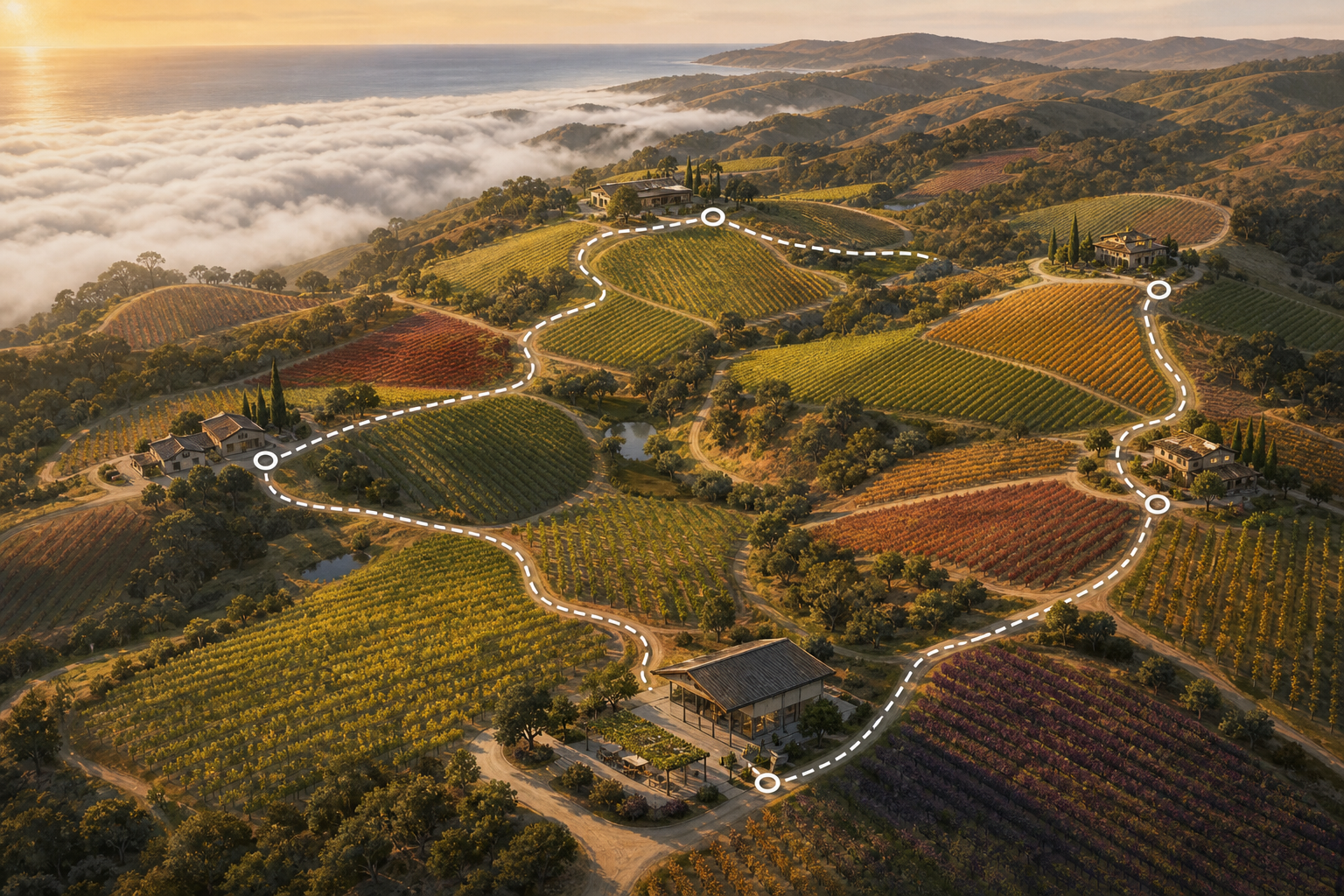
The style of wine in your glass is largely decided by geography before a single grape is harvested.
Explore wineries and wine trails near you
Discover wineries and tasting rooms in your area using the Local Eyes winery guide.
What a wine trail actually is
A wine trail is a mapped route connecting multiple wineries in a region, designed so visitors can move between them in a single outing. Trails are voluntary associations of regional wineries working together on shared marketing, signage, and sometimes joint ticketing. They do not have their own tax status and are not governed bodies. In some states, the definition is specific: Virginia's administrative code, for example, requires a trail to include at least three wineries that have declared their intention to operate together and published joint marketing materials, with no more than 15 miles between consecutive stops. The first organized wine trail in the United States was the Cayuga Lake Wine Trail in New York, launched in 1983. Trails in the Northeast actually predate European equivalents by roughly 30 years.
Tasting rooms without a vineyard still count
Not every winery you find nearby will sit on vineyard land. Many producers operate standalone tasting rooms in town centers, warehouse districts, or mixed-use neighborhoods, sourcing grapes from partner farms while keeping their production and hospitality in a more accessible location. This matters when you search for wineries near you: proximity to a tasting room does not always mean a scenic vineyard visit, and a scenic vineyard does not always offer drop-in tastings. Checking what a specific location actually offers, a sit-down flight, a self-guided cellar tour, a food pairing menu, or a simple bar pour, saves disappointment on arrival.
Reservations and tasting fees have changed significantly
Tasting fees have risen sharply across the United States. Nationally, tasting fees have roughly doubled since 2018, and in 2012 almost a quarter of American wineries still poured without charge at an average fee under ten dollars. Reservation requirements have also tightened: in Napa Valley, around 60 percent of wineries have kept the appointment-only model introduced during the pandemic, and a similar proportion of Sonoma wineries now operate on the same basis. Booking online is often less expensive than paying at the door where walk-ins are still permitted. Weekday appointments frequently cost less than weekend reservations, and tasting fees are sometimes waivable with a bottle purchase, though that is always at the winery's discretion.
Regional climate shapes what is in your glass
The style of wine a local winery produces is largely determined by where it sits. California produces around 80 percent of all US wine, and its Mediterranean-like climate suits full-bodied reds across much of the state. Areas closer to the Pacific coast, however, receive morning fog that moderates temperatures, making them well suited to cooler-climate whites and sparkling wines. Warmer inland valleys tend toward bold Cabernet Sauvignon and Zinfandel, while elevated or coastal sites often favor Pinot Noir, Chardonnay, and Riesling. Understanding the climate of the region you are visiting gives you a reasonable preview of what to expect in the glass before you arrive.
Passport programs and trail perks worth knowing
Many wine trails offer passport programs that bundle tastings across every member winery into a single purchase, which can make a full trail day more straightforward to budget. Some trails also organize themed weekends, harvest events, and food-pairing dinners that are only available to passport holders or advance ticket buyers. These programs vary widely by region, so checking the trail's own website or a local guide before you go is the most reliable way to find out what is currently on offer. Local Eyes covers wineries across its guide network, so searching by town is a practical starting point for finding which trails and tasting rooms are active near a specific location.
How to plan a winery visit near you
- 1
Identify the regional wine identity
Before choosing specific wineries, look up what grape varieties your region is known for. A coastal or elevated area will likely specialize in crisp whites or sparkling wines, while a warm inland valley tends toward bold reds. Knowing this shapes which stops will be most rewarding and helps you ask better questions during tastings.
- 2
Decide between a trail and individual stops
A wine trail connects multiple wineries along a mapped route, often with a passport program covering all stops. Individual winery visits give you more time at each location and work well if one producer's style or story is the main draw. Mixing both approaches on the same day is common: follow a trail in the morning and book a longer seated experience at one standout winery in the afternoon.
- 3
Check reservation requirements before you go
Many wineries, particularly in Napa and Sonoma, are now reservation-only. Arriving without a booking at these locations means being turned away. Check each winery's website or listing for its current policy, and book online where possible since online booking is often less expensive than the walk-in rate at locations that still accept them.
- 4
Review what each tasting experience includes
Tasting experiences vary from a simple flight of three or four wines at a bar to a guided seated session with food pairings and a cellar tour. Clarify in advance whether food is included or available to purchase, whether the fee is waivable with a bottle purchase, and whether the format is self-guided or hosted. This avoids surprises and helps you pace the day.
- 5
Plan logistics around the trail distance
On an organized wine trail, consecutive wineries are typically within a reasonable driving distance of each other. Plan a route in advance rather than navigating spontaneously, and designate a driver or arrange transport if you intend to taste at multiple stops. Many regions have dedicated wine country shuttle or taxi services specifically for trail visitors.
- 6
Use a local guide to find current listings
Winery hours, tasting formats, and trail membership change seasonally. A local guide like Local Eyes, which organizes wineries by town and region, gives you an up-to-date starting point. Cross-reference with the winery's own site for reservation links and any special events running during your visit.
Benefits
Trails connect multiple wineries in one outing
A wine trail lets you visit several producers along a single mapped route, often with a passport program that bundles tastings across all member wineries into one purchase, making the day easier to plan and navigate.
Knowing reservation rules saves the day
In major wine regions, the majority of wineries now operate on an appointment-only basis. Booking in advance, often online at a lower rate, is the single most practical step you can take before a winery visit.
Regional climate predicts the wine style
Coastal and elevated sites tend to produce crisp whites and sparkling wines, while warm inland valleys favor bold reds. Understanding a region's climate before you arrive sets accurate expectations for what you will find in the glass.
Tasting fees vary widely by region and format
Fees differ substantially depending on where you visit and what the experience includes. Weekday visits and online bookings are consistently less expensive than weekend walk-ins, and purchases sometimes offset the tasting fee at the winery's discretion.
Wine trail visits in practice
A weekend trip built around a trail passport
A couple visiting a wine region for a weekend picks up a trail passport that covers tastings at every member winery along a mapped route. They spend Saturday working through the northern half of the trail and Sunday on the southern stops, using the passport to keep the day simple and budget predictable. Booking a longer seated tasting at one standout winery on Sunday afternoon gives the trip a memorable anchor without requiring a full-day commitment at a single estate.
A local resident discovering nearby producers
A resident who has lived in a wine-producing region for years but never explored it systematically uses a local guide to find tasting rooms within a short drive. Several turn out to be urban tasting rooms in a nearby town center, open on weekday afternoons, with no reservation required and a short two-wine flight option that suits a casual after-work visit. This kind of discovery is common: local wineries are often undervisited by the people who live closest to them.
A group planning a winery day out
A group of friends organizing a day out uses a trail map to identify three wineries within a 15-mile stretch, books reservations at two of them in advance, and leaves the third as a flexible drop-in if time allows. They arrange a designated driver in advance and check each winery's food offering so they know where to plan a longer lunch stop. Planning the route and reservations the week before prevents the most common frustration of winery day trips: arriving at a fully booked location.
A traveler researching a destination's wine identity
A traveler visiting a new region for the first time uses a local guide to understand what the area's climate and soil produce before choosing which wineries to visit. Learning that the region's coastal fog favors Pinot Noir and sparkling wine rather than the bold Cabernets they expected helps them adjust their expectations and choose producers who specialize in those styles, resulting in a more satisfying visit.
Common questions about wineries near you
Find the best wineries and tasting rooms near you
Local Eyes covers wineries, tasting rooms, and wine trail stops organized by town, so you can find what is actually open and worth visiting near you. Browse the winery listings for your area, check current hours and formats, and plan your next visit with confidence.