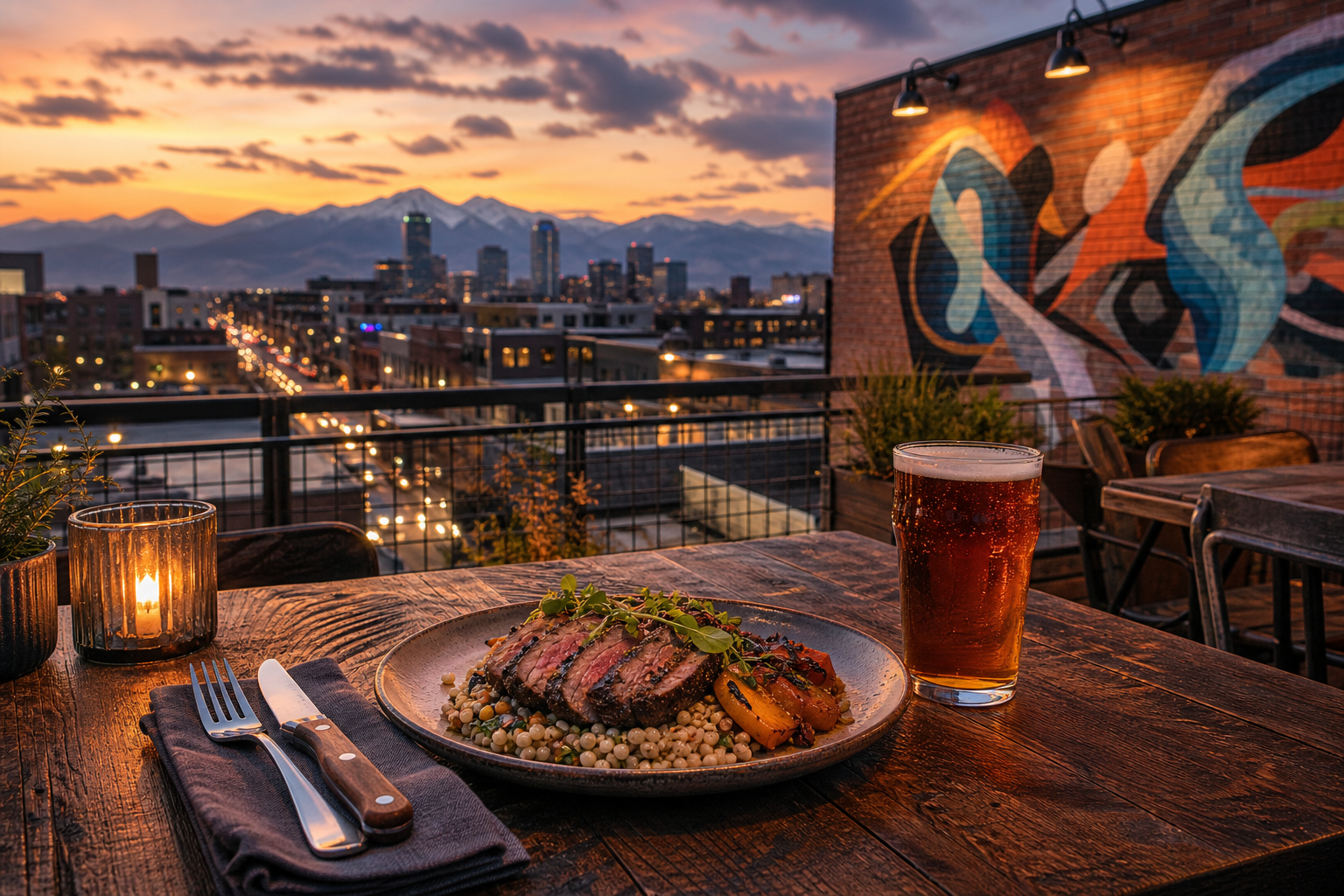
Game meat, Michelin stars, and food halls sharing the same city blocks: Denver's restaurant scene is wider than most visitors expect.
Find your next Denver restaurant on Local Eyes
Explore Denver's best dining neighborhoods and find your next great meal on Local Eyes.
Four neighborhoods that define Denver dining
Denver's restaurant scene concentrates in a handful of distinct neighborhoods, each with its own personality. RiNo (River North Art District) is widely regarded as the city's most dynamic dining quarter, pairing trailblazing restaurants with food halls and breweries against a backdrop of vibrant street art. LoHi (Lower Highlands) leans upscale, with rooftop restaurants offering downtown skyline views, Michelin-starred kitchens, and a nationally ranked speakeasy. Capitol Hill brings a grittier, more eclectic energy, while downtown anchors the city's most accessible dining, with dozens of options clustered around 16th Street Mall and a short stretch of 17th Street that locals call Denver's restaurant row. Knowing which neighborhood suits your mood is the first decision worth making.
Rocky Mountain ingredients that set Denver menus apart
Denver's proximity to the Rockies shapes what ends up on the plate in ways that are hard to replicate elsewhere. Game meat is not a novelty here: bison, elk, and venison appear across menus throughout the city, prepared by chefs who recognize these leaner proteins need different handling than conventional beef. The surrounding region's farms contribute ultra-sweet corn and peaches, while ranchers raise prized cattle, sheep, and bison. The Rocky Mountains supply foragers, hunters, and fishers with ingredients that flow directly into Denver kitchens. Buckhorn Exchange, which first opened in 1893, is the city's most iconic expression of this tradition, its menu still echoing the game that sustained Indigenous tribes and frontier settlers of that era.
Mexican food culture runs deep in Denver
Denver's Mexican food scene is not an afterthought. El Taco de Mexico is described as a lodestar of the city's thriving Mexican food culture and widely regarded as the mother of all Mexican food institutions in Denver. At the other end of the formality spectrum, Alma Fonda Fina holds a Michelin Star and offers seats at a chef's counter where guests can learn about distinctive recipes, Mexican culinary techniques, and the culture behind them. Xiquita Restaurante y Bar brings a Mexico City-inspired approach to the mix. This range, from beloved neighborhood institution to nationally recognized fine dining, reflects a broader truth about Denver: its growing and diversifying population has turned it into a globally minded food city drawing on Mexican, Vietnamese, Israeli, Ukrainian, Chinese, and other cuisines.
Food halls and markets worth building a visit around
Denver's food hall scene gives diners a concentrated way to sample the city's range. Denver Central Market occupies a 12,000-square-foot gastro hall with ten culinary vendors covering tuna poke, squid ink spaghetti, wood-fired pizzas, handcrafted chocolates, Italian beef sandwiches, an ice cream shop, a butcher, a fish counter, and a bar pouring progressive cocktails. The Source, which opened in 2013, helped establish RiNo as a food destination; its neighboring Source Hotel brought Safta, an Israeli restaurant from James Beard award-winning chef Alon Shaya, to the neighborhood. If you want to understand what Denver's food culture is doing at any given moment, these spaces are a useful shortcut. Pairing a food hall visit with a stop at one of the area's local farmers markets gives you an even fuller picture of what the region grows and produces.
Craft beer belongs in the dining conversation
Denver's craft beer culture is not separate from its restaurant scene: it is woven through it. Brewpubs anchor entire dining corridors, particularly in RiNo and downtown, and many restaurants build their menus around local pours. The pairing of regional ingredients with locally brewed beer is one of the more distinctive pleasures of eating in Denver, and it shows up everywhere from casual lunch spots to destination dinner menus. Downtown's historic district alone holds multiple brewpubs alongside its dining and nightlife options near Coors Field. If you're planning a longer trip, it's worth comparing Denver's approach to other food-forward cities: the Charleston dining scene offers an interesting contrast in how regional ingredients and local drink culture shape a city's restaurants.
How to plan a great meal in Denver
- 1
Start with neighborhood, not restaurant
Denver's dining neighborhoods each have a distinct character, so picking the right one for your mood saves time. LoHi suits upscale dinners and rooftop drinks; RiNo works well for exploratory eating across a food hall or a string of casual spots; downtown is the practical choice for lunch near 16th Street Mall or a meal before an event. Narrow the neighborhood first, then look at specific restaurants within it.
- 2
Match the occasion to the format
A quick weekday lunch near the office calls for something different than a destination tasting-menu dinner. Denver supports both extremes and everything between. For a special occasion, neighborhoods like LoHi offer Michelin-starred options and chef's counter experiences. For a casual group outing, a food hall like Denver Central Market lets everyone choose their own direction without compromising.
- 3
Factor in the regional ingredient story
If you are visiting Denver specifically to eat, putting at least one Rocky Mountain-focused meal on your itinerary is worth it. Bison and elk dishes, farm-sourced corn and peaches, and game preparations that connect to the region's history are things you can find here that you cannot easily replicate elsewhere. Buckhorn Exchange, open since 1893, is the most historically grounded option for this kind of meal.
- 4
Explore the Mexican food spectrum
Denver's Mexican food scene spans an unusually wide range. Starting at a beloved neighborhood institution like El Taco de Mexico gives you a baseline for the city's deep roots in this cuisine. Booking a seat at the chef's counter at Alma Fonda Fina (Michelin Star) offers a more structured, educational experience of Mexican culinary technique. Both ends of the spectrum are worth experiencing if your schedule allows.
- 5
Build craft beer into the plan
Denver's brewpubs and brewery-adjacent restaurants are not an afterthought to the dining scene. Many of the best casual meals in RiNo and downtown happen in spaces where the beer list is as considered as the food menu. Pairing a regional craft beer with a bison or elk dish is one of the more distinctively Denver experiences available, and it tends to happen at moderate price points rather than only at fine dining establishments.
Benefits
Neighborhood clarity saves time
Denver's dining options are large enough to be overwhelming without a framework. Organizing by neighborhood (LoHi for upscale, RiNo for creative and casual, downtown for convenience) gives any visitor or resident a practical starting point.
Regional ingredients are genuinely distinctive
Bison, elk, venison, and locally sourced produce are not menu gimmicks in Denver. Rocky Mountain game meat and farm produce appear because the supply chain is local, and the cooking tradition behind them goes back to 1893 and earlier.
Mexican food spans fine dining to institution
Denver's Mexican food culture is deep enough to support both a decades-old neighborhood institution and a Michelin-starred chef's counter experience, giving diners a genuine range to choose from.
Food halls reduce group decision fatigue
Denver Central Market and The Source offer ten or more vendors under one roof, making them practical solutions for groups with different tastes or anyone who wants to sample broadly without committing to a single menu.
Craft beer is part of the dining experience
Denver's brewpub culture is woven into its restaurant scene rather than existing separately. Pairing local beer with regional food is a distinctively Denver experience available across a wide range of price points and settings.
Denver dining situations worth planning for
A visitor wanting one definitive Denver meal
A traveler with a single evening in Denver and no prior knowledge of the city does best by anchoring to a neighborhood rather than a single famous name. Heading to LoHi for dinner covers the most ground: rooftop views, Michelin-level cooking, and a neighborhood energy that reflects what Denver has become. Booking ahead is advisable for any chef's counter or tasting menu experience. For comparison, see how other cities organize their dining scenes in guides like the Gainesville restaurant guide.
A group with mixed tastes and budgets
Denver Central Market's ten-vendor format is built for exactly this situation. One person orders wood-fired pizza, another goes to the fish counter, a third picks up handcrafted chocolates for dessert, and everyone meets at the bar. No single menu has to satisfy everyone, which removes the friction of group dining entirely. The Source food hall in RiNo operates on a similar logic.
A local resident exploring beyond their usual spots
Denver residents who have settled into a rotation of familiar restaurants often overlook how much the city's scene has changed in recent years. RiNo's food hall and brewery corridor has expanded significantly, and the Mexican fine dining category now includes Michelin-recognized restaurants that did not exist a decade ago. Using a neighborhood-by-neighborhood approach, rather than searching by cuisine alone, tends to surface restaurants that would not otherwise come up.
A food-focused traveler planning a longer stay
Someone spending several days in Denver with eating as a primary goal can structure the trip around neighborhoods: a food hall afternoon in RiNo, a game-meat dinner at a historic restaurant downtown, a chef's counter experience in LoHi, and a morning visit to a local farmers market to see the regional produce that supplies many of these kitchens. This kind of itinerary reveals the full range of what makes Denver's food scene distinctive rather than sampling it at random.
Denver restaurants: questions locals and visitors ask
Ready to find your next Denver restaurant
Denver's restaurant scene rewards a little planning: pick the right neighborhood for your occasion, leave room for a regional ingredient you have not tried before, and let the city's range surprise you. Browse Denver restaurant listings on Local Eyes to find what fits your next meal.